A redox predictor needs a structure checkpoint
A project note on the SciencesLoop Redox RFB Predictor: why name resolution, editable structures, and explicit confirmation come before an electrochemical prediction.
A molecule name is not yet a model input. It is a request to identify a molecule.
I built the SciencesLoop Redox RFB Predictor to estimate an organic molecule’s aqueous redox potential from its structure. The first version accepted a SMILES string. That was technically enough for the model, but it was not enough for a useful scientific interface.
Most people do not begin with canonical SMILES. They begin with a name: TEMPO, p-benzoquinone, anthraquinone, or a shorthand from a paper. A name can be misspelled, ambiguous, or refer to a different charge or radical state. If the system silently turns that name into a structure, the model may return a clean number for the wrong molecule.
That is the failure mode I wanted to make visible.
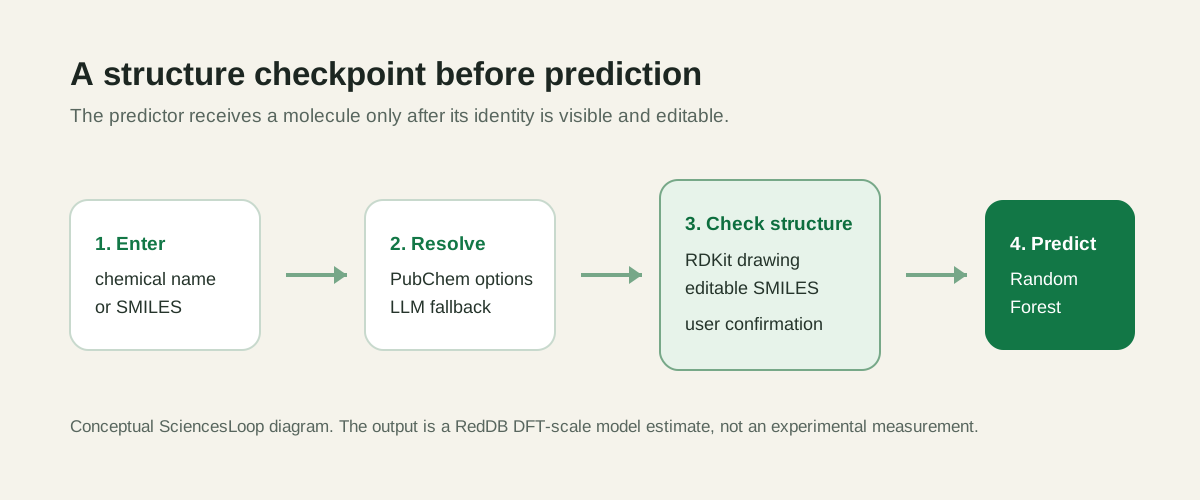
The live workflow
The demo now has four separate steps:
- Enter a SMILES string or a chemical name.
- If it is a name, inspect possible standardized name matches before seeing a structure.
- Inspect the RDKit-rendered 2D structure and canonical SMILES. Edit the SMILES directly, redraw it, or ask the structure assistant for up to three proposed edits.
- Confirm one structure, then request the potential prediction.
For name lookup, the service uses PubChem PUG-REST first. This is important. An LLM can be useful for a typo or a requested structure change, but it should not be the default authority for a chemical identity. When PubChem has no match, the LLM may propose labeled candidates; each candidate is then parsed and drawn by RDKit before it is shown.
The user still makes the final identity check. RDKit can tell us whether a SMILES parses and can render it. It cannot tell us whether that valid SMILES is the molecule the user meant.
A concrete example: TEMPO
TEMPO is a good stress test because it is a nitroxide radical and the charge
or radical state matters. In the demo, entering tempo first shows possible
name matches. Selecting TEMPO retrieves the PubChem structure, which is then
canonicalized by RDKit as:
CC1(C)CCCC(C)(C)N1[O]The user sees that structure before prediction. They can also ask the structure assistant for the oxoammonium form, inspect the returned candidate, and either select it or edit its SMILES. This does not make the resulting electrochemical number experimentally trustworthy. It only makes the structure passed to the model inspectable.
That distinction matters here because the current model was trained mainly on RedDB quinones and aza-aromatics. TEMPO-like radicals sit outside its main training chemistry. A correctly resolved input can still be an extrapolation.
What actually predicts the number
The live prediction model is deliberately simple and fixed:
confirmed canonical SMILES
  → 26 RDKit descriptors + 1,024-bit Morgan fingerprint
  → Random Forest with 300 trees
  → estimated aqueous redox potential, V vs SHE
The target is RedDB’s DFT-derived aqueous redox-potential scale, not an experimental measurement. RedDB is a computational database of electroactive molecules developed for redox-flow-battery research; the underlying data paper is Sengul et al., Scientific Data (2022).
The LLM is outside this prediction path. Its constrained job is to help with a name that PubChem cannot resolve or a user-requested structure edit. It does not estimate potential, run DFT, or replace review of the displayed molecule.
My read
The interesting part of this demo is not the chat box. It is the checkpoint.
For molecular machine learning, the user-facing chain should be visible:
requested name → chosen identity → displayed structure → confirmed model input → predictionOtherwise a reasonable-looking prediction can hide the most basic error in the workflow: the wrong molecule was sent to the model.
The next improvement I would make is an explicit applicability-domain warning. The interface already says that molecules far from the quinone and aza-aromatic training domain are extrapolations. I want to turn that into a concrete, structure-based signal before anyone uses the demo for screening decisions.
Try the live Redox RFB Predictor. The full implementation, endpoints, and operational rules are documented in the public repository.
Discuss this note
GitHub commentsLoading comments connects to Giscus and GitHub Discussions. Posting requires a GitHub account.